 English
Blog


2025-12-30 10:39:49
Material selection lies at the core of product performance and cost structure within the automotive webbing market.Among all available options,polyester and nylon dominate the Automotive webbing industry,accounting for the vast majority of applications worldwide.While both materials offer high strength and durability,their distinct characteristics shape how they are used across different automotive safety and interior systems.
As the automotive webbing market size continues to grow alongside global vehicle production,the debate between polyester and nylon has shifted from simple material preference to strategic application-driven decision-making.
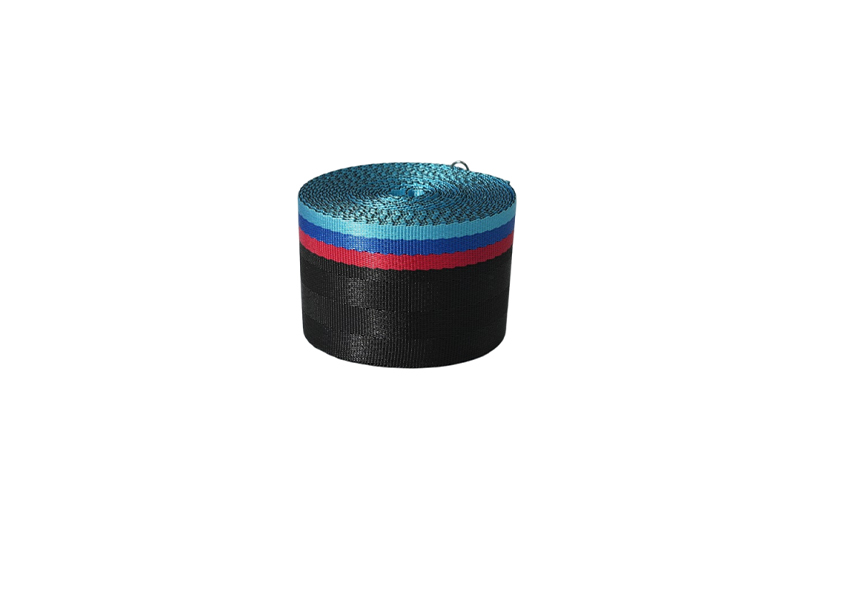
Polyester has emerged as the most widely used material in the automotive webbing industry,particularly in seat belt applications.Its dominance is driven by a balanced combination of strength,low elongation,UV resistance,and long-term dimensional stability.In safety-critical systems,controlled elongation under load is essential to manage energy absorption during collisions.Polyester’s lower stretch compared to nylon allows for more predictable performance,making it the preferred choice for most OEM seat belt systems.
Another key advantage of polyester is its resistance to environmental factors.Automotive interiors are exposed to heat,humidity,and prolonged sunlight,especially in regions with extreme climates.Polyester maintains its mechanical properties better under UV exposure and thermal aging,reducing long-term degradation.This durability contributes directly to its widespread adoption and reinforces its position as the backbone material of the automotive webbing market.
Cost efficiency also plays a major role.Polyester fibers are generally more cost-stable and widely available,enabling large-scale production with consistent pricing.For high-volume vehicle manufacturing,this stability is critical.As a result,polyester-based webbing significantly influences the overall automotive webbing market size,especially in mass-market passenger vehicles.
Nylon,on the other hand,remains an important material within the automotive webbing industry,particularly for specialized or high-performance applications.Nylon offers higher elasticity and superior abrasion resistance compared to polyester.These properties make it suitable for dynamic load scenarios,where flexibility and shock absorption are prioritized over dimensional stability.
In applications such as airbags,interior restraint straps,or certain commercial vehicle systems,nylon webbing provides excellent energy absorption and resilience.Its ability to recover after deformation can extend service life in components exposed to repeated stress cycles.However,nylon’s higher moisture absorption and sensitivity to UV exposure require additional treatments or coatings,which can increase production costs.
The choice between polyester and nylon is rarely absolute.Instead,it reflects a careful balance between performance requirements,regulatory compliance,and cost considerations.Hybrid solutions are also gaining attention within the automotive webbing market.Some manufacturers blend material properties through advanced weaving techniques or surface treatments,creating webbings that combine polyester’s stability with nylon’s flexibility.
From a market development standpoint,sustainability is increasingly influencing material dominance.As environmental regulations tighten,recycled polyester is gaining traction within the automotive webbing industry.OEMs seeking to reduce carbon footprints are integrating recycled fibers without sacrificing performance,further strengthening polyester’s market position.This trend is expected to positively impact the automotive webbing market size by opening new eco-focused product segments.
Regional differences also shape material preferences.In Europe,strict safety and environmental standards reinforce polyester’s dominance,while certain Asia-Pacific manufacturers continue to utilize nylon in cost-sensitive or niche applications.North America shows a mixed pattern,with polyester leading in passenger vehicles and nylon maintaining relevance in commercial and specialty vehicles.
Looking ahead,material innovation will continue to reshape the automotive webbing market.Advances in fiber engineering,coatings,and smart textiles may blur the line between polyester and nylon dominance.However,based on current production volumes and OEM specifications,polyester is expected to remain the primary material driving growth in the automotive webbing market size over the next decade.
In summary,while both polyester and nylon play vital roles,polyester clearly dominates the automotive webbing industry due to its balanced performance,durability,and cost efficiency.Nylon complements this dominance by serving specialized needs where flexibility and abrasion resistance are critical.Together,these materials form the foundation of a dynamic and evolving automotive webbing market.

Dongguan City Wanxinlong Technology Co., Ltd. Is a trusted provider of semi-finished accessories and personal protective equipment (PPE).

Business wechat
Copyright © 2026 Dongguan City Wanxinlong Technology Co., Ltd. All rights reserved.


