 English
Blog


2026-06-17 16:06:01
When people search for a Tree-Climbing Harness,they often focus on features such as comfort,weight capacity,and safety certifications.However,one of the most important factors is often overlooked—the materials used to build the harness.
For professional arborists,rescue personnel,and rope access technicians,a harness must do much more than simply support body weight.It must withstand constant friction against tree bark,prolonged suspension,changing weather conditions,and heavy equipment loads.That is why modern Tree Climbing Harness systems are engineered using a combination of high-strength webbing,reinforced stitching,advanced metal hardware,and ergonomic support materials.
A professional Arborist Harness is designed for demanding environments where equipment failure is not an option.Whether working in tree care,industrial rope access,mountaineering,or rescue operations,climbers depend on their harness to provide stability and secure attachment points throughout the workday.
Premium industrial-grade Harnesses are specifically engineered to function as both fall protection and rope access systems.These advanced designs combine structural strength,ergonomic comfort,and multiple anchorage points to support complex climbing and suspension activities in extreme-height environments.
For this reason,the quality of every material used in the harness directly impacts safety,durability,and long-term performance.
The foundation of most professional Tree-Climbing Harness products is heavy-duty nylon webbing.
Nylon is widely used because it offers exceptional tensile strength while remaining flexible enough to move naturally with the climber.During tree maintenance operations,harness webbing constantly rubs against rough bark surfaces,ropes,and equipment.Reinforced nylon helps resist abrasion and maintain structural integrity under repeated use.
Many arborists prefer nylon-based harnesses because they provide a balance of strength,comfort,and reliability during long hours of climbing and positioning work.
Tree care professionals spend most of their time outdoors,making weather resistance an important consideration.
Polyester is commonly incorporated into Tree Climbing Safety Harness designs because it performs well under prolonged exposure to sunlight,moisture,and changing temperatures.Compared with many other synthetic fibers,polyester offers excellent UV resistance and reduced moisture absorption.
As a result,many manufacturers combine nylon and polyester to create harnesses that deliver both strength and environmental durability.
Metal hardware is another essential component of professional Tree Climbing Equipment.
Aircraft-grade aluminum is frequently used for buckles,side attachment points,and D-rings.Its high strength-to-weight ratio allows climbers to carry less weight without compromising safety.
For arborists who spend an entire day moving through the canopy,lightweight hardware can significantly reduce fatigue while improving mobility and overall efficiency.
Steel Components for Critical Load Points
Certain sections of a Professional Tree-Climbing Harness may use forged steel hardware instead of aluminum.
Steel is commonly selected for critical load-bearing areas because of its exceptional durability and resistance to deformation.In industrial rope access and rescue applications,where equipment may experience repeated heavy loads,steel components provide an additional level of confidence.
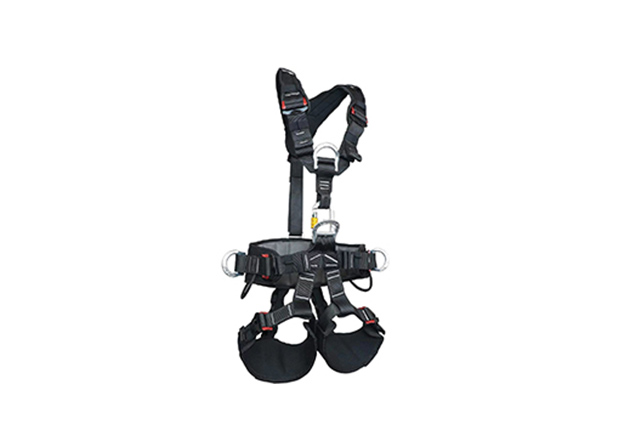
A harness designed for professional use must also remain comfortable during extended periods of suspension.
Advanced Arborist Harness systems often include breathable mesh fabrics,ergonomic waist supports,and high-density foam padding.These materials help distribute pressure evenly across the body and reduce discomfort during long climbing or rescue operations.
This becomes especially important for professionals involved in technical climbing,fire rescue,or industrial rope access,where workers may remain suspended for extended periods.
Material quality alone is not enough.Professional harnesses should also comply with recognized international safety standards.
Many premium Tree-Climbing Harness systems are CE certified and manufactured in accordance with EN 361,EN 358,and EN 813 requirements.These standards help ensure that the webbing,stitching,hardware,and attachment points perform reliably in high-risk working environments.
For arborists,rescue teams,and technical climbers,certification provides additional assurance that the equipment has been designed and tested to meet professional safety expectations.
Modern Tree-Climbing Harness products are typically constructed from high-strength nylon webbing,weather-resistant polyester fibers,lightweight aluminum hardware,durable steel components,and ergonomic comfort materials.Together,these materials create a reliable fall protection and rope access system capable of supporting demanding applications in tree care,rescue operations,mountaineering,and industrial climbing.
Choosing a harness built from premium materials not only improves durability and comfort but also helps ensure safer performance when working at height.

Aplexus Industrial Co.,Ltd Is a trusted provider of semi-finished accessories and personal protective equipment (PPE).

Business wechat
Copyright © 2026 Aplexus Industrial Co.,Ltd All rights reserved.


