 English
Blog


2026-06-17 16:43:01
Many people assume that a Tree-Climbing Harness is simply a collection of straps and buckles.However,professional arborists know that the materials used in a harness can make a significant difference in comfort,durability,and safety.
A climber working in a tree canopy may spend six to eight hours suspended above the ground.During that time,the harness constantly rubs against rough bark,supports the climber's body weight,carries tools,and remains exposed to sunlight,moisture,and changing weather conditions.That's why professional manufacturers carefully select materials that can withstand these demanding environments.
So,what materials are tree-climbing Harnesses actually made from,and why are they chosen?
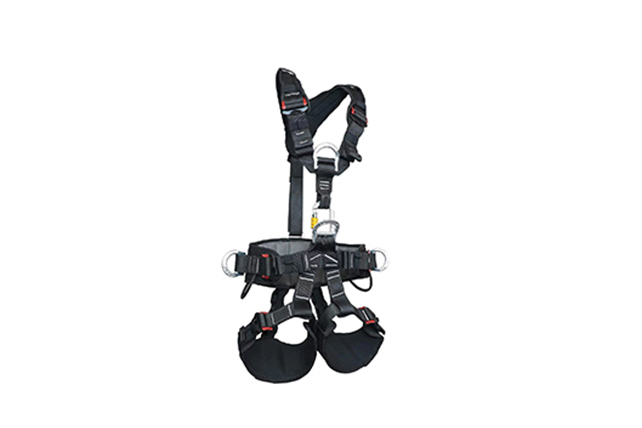
If you look closely at a professional Arborist Harness,you'll notice that most of its structure is made from webbing rather than metal.
The majority of high-quality Tree Climbing Harness systems use industrial-grade Nylon Webbing because it offers an excellent balance of strength,flexibility,and abrasion resistance.
For arborists,abrasion resistance is especially important.Every climb involves contact with tree bark,branches,ropes,and hardware.Over time,these surfaces can wear down lower-quality materials.Heavy-duty nylon helps resist this daily wear while remaining comfortable enough for long working hours.
Many experienced climbers consider webbing quality one of the most important factors when choosing a harness because it is often the first component exposed to continuous friction.
Although nylon provides outstanding strength,many manufacturers also incorporate polyester into their Tree Climbing Safety Harness designs.
The reason is simple:outdoor work is harsh on equipment.
Arborists,rescue teams,and rope access technicians frequently work in direct sunlight.Ultraviolet exposure can gradually weaken certain materials over time.Polyester offers better UV resistance and lower moisture absorption,making it a valuable addition to harness construction.
This is why premium harnesses rarely rely on a single material.Instead,they combine nylon and polyester to balance flexibility,strength,and weather resistance.
One common complaint among climbers is equipment weight.
A harness that feels comfortable on the ground can become tiring after several hours in a tree.To reduce unnecessary weight,many modern Tree-Climbing Harness models use aircraft-grade aluminum alloy for buckles,side attachment points,and D-rings.
Aluminum provides impressive strength while remaining significantly lighter than steel.For arborists who climb daily,lighter hardware can improve mobility and reduce fatigue throughout the workday.
This is particularly beneficial when carrying chainsaws,ropes,carabiners,and other climbing equipment.
If aluminum is lighter,why do some manufacturers continue using steel?
The answer lies in durability.
Critical load-bearing attachment points are often constructed from forged steel because of its exceptional resistance to wear and deformation.Rescue professionals and industrial rope access technicians frequently operate in environments where equipment is subjected to repeated heavy loading.
In these situations,the additional durability of steel can be a major advantage.
Many premium harnesses strategically combine aluminum and steel,using each material where it performs best.
When people evaluate a harness,they often focus on weight ratings and safety certifications.Yet comfort can be just as important.
A climber who spends several hours suspended in an uncomfortable harness may experience pressure points,restricted movement,and increased fatigue.
For this reason,advanced Tree-Climbing Harness systems typically include breathable mesh fabrics,ergonomic waist support,and high-density foam padding.These materials help distribute body weight more evenly and improve comfort during prolonged suspension.
This becomes especially important for professional tree care operations,rope access work,and technical rescue missions where workers may remain suspended for extended periods.
High-quality materials alone are not enough.Professional harnesses must also meet recognized safety requirements.
Many industrial-grade Tree Climbing Harness products are designed as complete fall protection and rope access systems for arborists,rescue teams,and technical climbers working in extreme-height environments.
To ensure reliable performance,premium models are often CE certified and comply with EN 361,EN 358,and EN 813 standards.These certifications help verify that the webbing,hardware,stitching,and attachment points can perform safely in demanding professional applications.
Whether used for tree care,industrial rope access,mountaineering,or fire rescue,certified equipment provides an additional level of confidence when working at height.
This is one of the most common questions among buyers.
In reality,no single material is responsible for a harness's lifespan.Durability depends on the quality of the webbing,stitching,hardware,and overall construction.
However,most experienced arborists agree that regular inspection matters just as much as material selection.Even the best harness should be checked for frayed webbing,damaged stitching,corrosion,and excessive wear before every climb.
A properly maintained harness made from premium materials can provide years of reliable service in demanding environments.
Conclusion
A professional Tree-Climbing Harness is far more than a collection of straps and buckles.It is a carefully engineered safety system that combines industrial-grade nylon webbing,weather-resistant polyester fibers,lightweight aluminum hardware,durable steel components,reinforced stitching,and ergonomic comfort materials.
Each material plays a specific role in helping arborists,rescue teams,and rope access professionals work safely and efficiently at height.Understanding why these materials are used can help climbers choose equipment that delivers the right balance of durability,comfort,and long-term performance.

Aplexus Industrial Co.,Ltd Is a trusted provider of semi-finished accessories and personal protective equipment (PPE).

Business wechat
Copyright © 2026 Aplexus Industrial Co.,Ltd All rights reserved.


